<?xml version="1.0" encoding="UTF-8"?>
<feed xmlns="http://www.w3.org/2005/Atom">
  <title type="text">Discover Indiana</title>
  <updated>2026-04-17T19:48:36+00:00</updated>
  <generator uri="http://framework.zend.com" version="1.12.20">Zend_Feed_Writer</generator>
  <link rel="alternate" type="text/html" href="https://discoverindianahistory.org.curatescape7.reclaim.hosting/"/>
  <link rel="self" type="application/atom+xml" href="https://discoverindianahistory.org.curatescape7.reclaim.hosting/items/browse?output=rss2"/>
  <id>https://discoverindianahistory.org.curatescape7.reclaim.hosting/</id>
  <author>
    <name>Discover Indiana</name>
    <uri>https://discoverindianahistory.org.curatescape7.reclaim.hosting</uri>
  </author>
  <link rel="hub" href="https://pubsubhubbub.appspot.com/"/>
  <entry>
    <title type="html"><![CDATA[Allen Chapel AME (Terre Haute)]]></title>
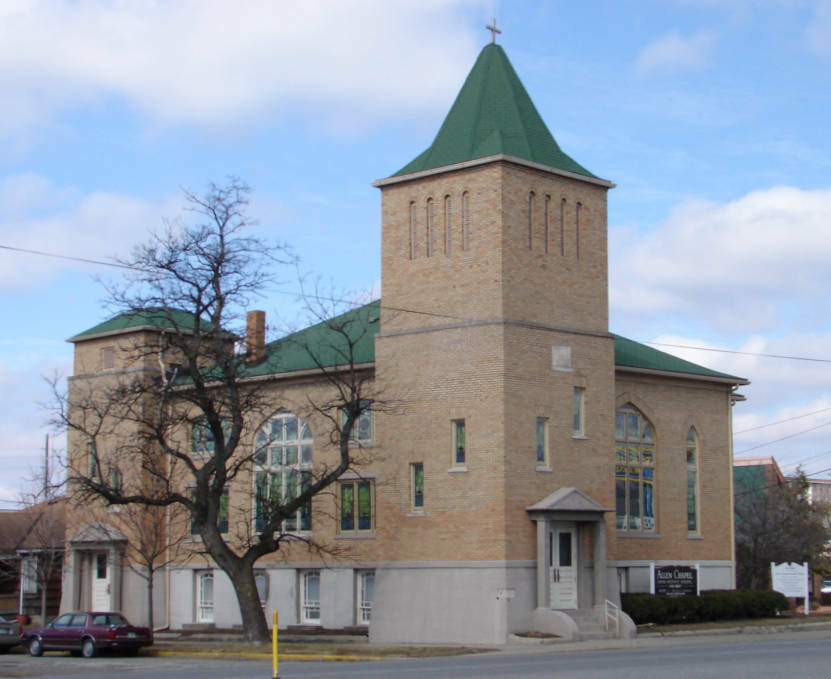
    <summary type="html"><![CDATA[<p><strong><em>Vigo County is a well-known site of early African American settlement, having close to 100 residents in 1820. ‘Lost Creek’ is identified as one of Terre Haute’s oldest Black settlements. A common identifier of Black settlement in Vigo County is the establishment of an AME church in Terre Haute. Allen Chapel African Methodist Episcopal (AME) serves as a bulwark of Terre Haute’s history, a reminder of the support which churches gave to early Black communities. Allen Chapel fits into the larger AME community of South-Western Indiana.</em></strong></p><img src="https://discoverindianahistory.org.curatescape7.reclaim.hosting/files/fullsize/4ed40527222c54ddd4c8d69339a4b217.jpg" alt="Allen Chapel" /><br/><p>Terre Haute’s Allen Chapel of the AME Church has stood at Third and Crawford Streets since 1870. However, the Terre Haute Congregation goes back to 1837, being housed in a small white church. Founding congregants enlisted the help of Rev. William Paul Quinn to assist their congregation. Allen Chapel AME served as a stop on the Underground Railroad, placed near the Wabash River route. The Terre Haute congregation is recorded as having around 74 members between 1841 and ’45.</p><p>Hiram Rhoads Revels, the pioneer of Allen Chapel’s educational mission, went on to serve as the first Black U.S. senator and, later, the first president of Alcorn State University. Similarly, James Hinton, the first Black man to serve in the Indiana General Assembly, attended Allen Chapel School. Allen Chapel set out to design a new church in 1868, enlisting Frederick Douglass to raise money for the construction. When the church was dedicated in 1870, they were presented with the bell used in the first Vigo County Courthouse. Allen Chapel trustee Zachariah M. Anderson became Terre Haute’s first Black public school teacher.  Even Jackie Robinson spoke to the congregation about his experience as a Major League Baseball player.</p><p>In 1913, a lightning strike engulfed the upper levels of Allen Chapel in flames. The unique tracker action pipe organ was saved, as well as some pews, but much of the original building was destroyed. The reconstructed Allen Church is yellow brick and stone, featuring a corner bell tower. Its prominent green roof curves into points and slopes, topping off the corner tower with a cross.</p><p>Urban redevelopments in the 1960s cut into Allen Chapel’s congregation and the building fell into minor disrepair. At a certain point demolition of the historic site became likely. Because of this threat, ‘Friends of Historic Allen Chapel AME’ formed to raise the necessary funds to preserve the building. Terre Haute’s congregation still operates to this day. Allen Chapel has been on the National Register of Historic Places since 1975.</p><p><em><strong><a href="https://discoverindianahistory.org.curatescape7.reclaim.hosting/items/show/622">For more view the original article</a></strong></em></p>]]></summary>
    <published>2023-06-21T13:43:54+00:00</published>
    <updated>2026-04-17T19:48:36+00:00</updated>
    <link rel="alternate" type="text/html" href="https://discoverindianahistory.org.curatescape7.reclaim.hosting/items/show/622"/>
    <id>https://discoverindianahistory.org.curatescape7.reclaim.hosting/items/show/622</id>
    <author>
      <name>Preston Reynolds</name>
    </author>
  </entry>
  <entry>
    <title type="html"><![CDATA[Bethel AME (Corydon)]]></title>
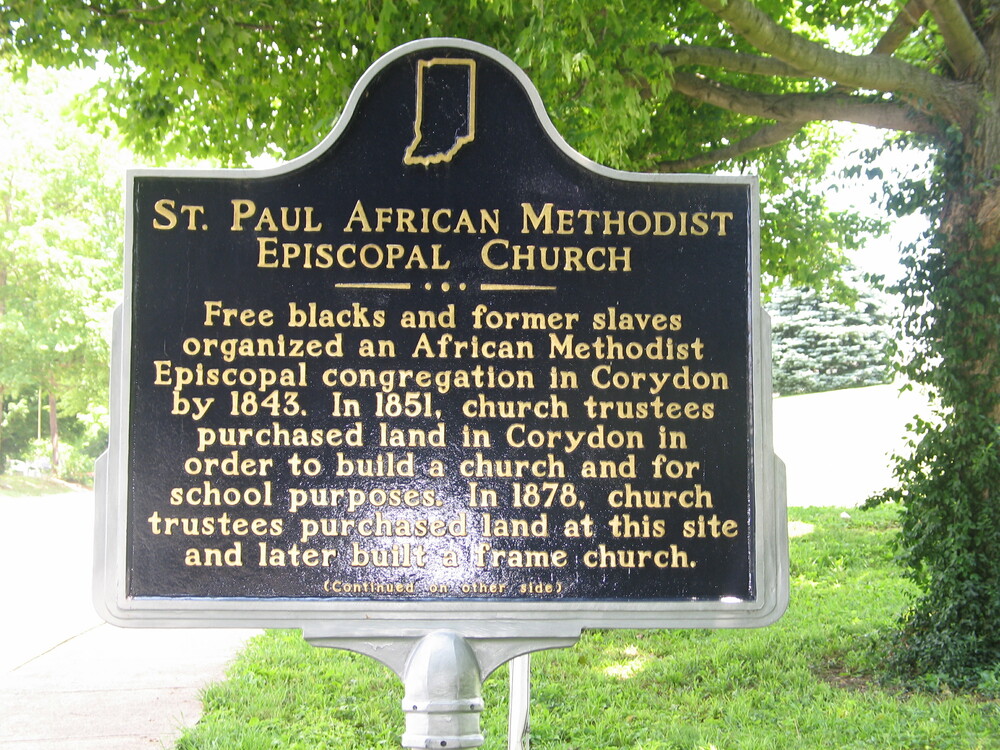
    <summary type="html"><![CDATA[<p><strong><em>	A short time after the 1814 census, Harrison County saw the arrival of around 100 African Americans, many of which took the name ‘Mitchem’. While these were not the first blacks to arrive in Harrison, their settlement made up much of the county’s Black demographic before the Civil War. St. Paul African Methodist Episcopal Church of Corydon is well representative of Indiana’s role in pre-Civil War Black migration. Their continued operation services the local history and community, representing Indiana’s history with segregated services and discrimination.</em></strong></p><img src="https://discoverindianahistory.org.curatescape7.reclaim.hosting/files/fullsize/c66a65006df8da8d3bd22f5d7c75b22c.jpg" alt="Front of Plaque" /><br/><p>St. Paul AME has stood at the corner of Maple and High Streets since 1975. Yet, the history of AME in Corydon goes back to 1843, when free Blacks and former slaves established the congregation. From 1840-45, Corydon was recorded as having around 12 congregants. By 1851 St. Paul AME served both as a church and school and in 1878 they constructed a framed building. St. Paul dedicated their congregation in honor of William Paul Quinn, one of the most influential Indiana Methodist Bishops. The ‘South Hill’ location attracted many African American immigrants to Corydon.</p><p>St. Paul AME shared operations with the Leora Brown School. Built in 1891, the institution served as a hub for African American education in a period when they were barred from public schools. Segregated schooling was legally sanctioned from 1869 to 1949. A traditional steepled brick building, St. Paul AME church is a relatively new construction. St. Paul AME has been a State Historical Site since 2003.</p><p><em><strong><a href="https://discoverindianahistory.org.curatescape7.reclaim.hosting/items/show/621">For more (including 4 images) view the original article</a></strong></em></p>]]></summary>
    <published>2023-06-21T13:18:23+00:00</published>
    <updated>2026-04-17T19:48:36+00:00</updated>
    <link rel="alternate" type="text/html" href="https://discoverindianahistory.org.curatescape7.reclaim.hosting/items/show/621"/>
    <id>https://discoverindianahistory.org.curatescape7.reclaim.hosting/items/show/621</id>
    <author>
      <name>Preston Reynolds</name>
    </author>
  </entry>
  <entry>
    <title type="html"><![CDATA[The Beech Church and Settlement ]]></title>
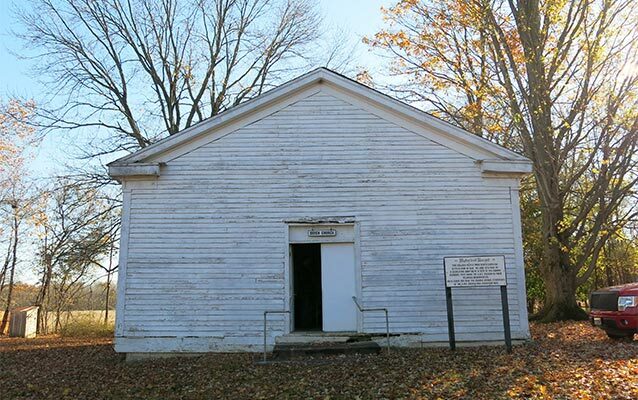
    <summary type="html"><![CDATA[<p><strong><em>The Blue River Congregation of Rush County goes back to 1832 when the early congregants resolved to adopt the AME Church as their denomination. </em></strong></p><img src="https://discoverindianahistory.org.curatescape7.reclaim.hosting/files/fullsize/764c36d3d001eeb775565b57b054236f.jpg" alt="Beech Church Front" /><br/><p>Free people of color were drawn to settle near Ripley Township, a predominantly Quaker settlement, with the promise of affordable land and friendly neighbors. The 1830 U.S. Census reported 14 Black households with a total of 91 individuals in the area. By the mid-1830s, Ripley township boasted over 400 Black residents, many moving from the US South. </p><p>The Blue River Congregation of Rush County goes back to 1832 when the early congregants resolved to adopt the AME Church as their denomination. Early leaders included Bishop Morris Brown and Rev. William Paul Quinn. The Blue River Church initially met in a log meeting house but replaced it with a frame building in 1838. From 1840-45, the Blue River Congregation is recorded as having around 102 members. The adjacent gravesite served as the resting place for Black residents of Rush County until the early 20th century. </p><p>Blue River was the site of ‘The Indiana Conference’ on October 2nd, 1840. The Indiana Conference organized the varying groups of religious followers into one central body. Morris Brown presided over the meeting, placing William Paul Quinn in charge of the circuit of Indiana AME Churches. The conference recorded forty-five AME congregations in Indiana. Indiana was the sixth AME conference founded and the fifth founded in the United States. </p><p>Blue River is a simple, single-room, gable-front, wood-frame building. The siding and roof shape are meant to resemble a Greek-revival setting. Greek-revival architecture, common in the US from the 1830s to 1860s, was heavily inspired by the architecture of classic Greek temples. Some characteristics of this style include triangular or gabled roofs with ends that continue into the center of the building and clapboard or paneled exteriors. The original 1838 building still stands. Since 1914, descendants of the Beech Settlement return to Blue River every August. Blue River remains one of the few sites associated with the rural Black community of Indiana. The site has also been referred to as ‘The Beech Church’ and ‘Point Pleasant’. The Beech Church has been listed in the National Register of Historic Places since 2018. </p><p><em><strong><a href="https://discoverindianahistory.org.curatescape7.reclaim.hosting/items/show/620">For more (including 5 images) view the original article</a></strong></em></p>]]></summary>
    <published>2023-06-20T16:00:06+00:00</published>
    <updated>2026-04-17T19:48:36+00:00</updated>
    <link rel="alternate" type="text/html" href="https://discoverindianahistory.org.curatescape7.reclaim.hosting/items/show/620"/>
    <id>https://discoverindianahistory.org.curatescape7.reclaim.hosting/items/show/620</id>
    <author>
      <name>Preston Reynolds&amp;#32;&amp;amp;&amp;#32;Samantha Rice</name>
    </author>
  </entry>
</feed>