<?xml version="1.0" encoding="UTF-8"?>
<feed xmlns="http://www.w3.org/2005/Atom">
  <title type="text">Discover Indiana</title>
  <updated>2026-04-17T19:48:37+00:00</updated>
  <generator uri="http://framework.zend.com" version="1.12.20">Zend_Feed_Writer</generator>
  <link rel="alternate" type="text/html" href="https://discoverindianahistory.org.curatescape7.reclaim.hosting/"/>
  <link rel="self" type="application/atom+xml" href="https://discoverindianahistory.org.curatescape7.reclaim.hosting/items/browse?output=rss2"/>
  <id>https://discoverindianahistory.org.curatescape7.reclaim.hosting/</id>
  <author>
    <name>Discover Indiana</name>
    <uri>https://discoverindianahistory.org.curatescape7.reclaim.hosting</uri>
  </author>
  <link rel="hub" href="https://pubsubhubbub.appspot.com/"/>
  <entry>
    <title type="html"><![CDATA[The Irish in Terre Haute: Civil War Commander Thomas Francis Meagher in Terre Haute]]></title>
    <summary type="html"><![CDATA[<img src="https://discoverindianahistory.org.curatescape7.reclaim.hosting/files/fullsize/db55103677b7ed9728c24adba23d713e.jpg" alt="Meagher in Battle" /><br/><p>As the number of Irish immigrants and descendants grew in the state of Indiana, many people started to pay attention to the politics abroad in Ireland. Between the Great Famine (1845-1849) and calls for legislative reform and independence from the British Empire, many Irish moved out of Ireland but remained interested in their homeland.</p><p>Thomas Francis Meagher was born in Waterford, Ireland in 1823. In 1847, he co-founded the Irish Confederation— a group dedicated to an independent Ireland—with three others. After lecturing on anti-British ideas in public in 1848, Meagher was convicted of encouraging rebellion against the British government and was to be sent to Australia. In 1851, Meagher escaped to the United States where he became famous for his work for Irish independence.</p><p>Meagher connected with Irish communities, especially those in Indiana. An 1852 letter from Indiana’s governor, Joseph A. Wright, appeared in the Daily State Sentinel. In the letter, Wright wrote to Meagher on behalf of the General Assembly to ask that he come to the state: “You will find in this State many of your noble and generous hearted countrymen – some of our best citizens – who, together with the native citizens of Indiana, will give a cordial greeting to your arrival,” Wright wrote. While Meagher respectfully declined the invitation, he did make his way to Indiana in 1858. The Terre Haute Daily Union reported that Meagher would be delivering a lecture at the Universalist Church about Saint Patrick’s Day, national anniversaries, and “their significance and beauty – their harmony with the American Republic.”</p><p>During the Civil War, Meagher captained part of the 69th New York Regiment, which was also known as the Irish Brigade as most of the men were Irish. He was influential in encouraging other Irishmen, both those born in the United States and those from Ireland, to enlist in the Union Army. In 1861, Meagher became the Brigadier General of the Irish Brigade. The Irish Brigade had a hand in multiple Civil War battles, such as Fair Oaks, Antietam, Fredericksburg. After the Civil War, Meagher became the Secretary of the Montana Territory. In 1867, Meagher fell from a steamboat on the Missouri River and drowned.</p><p><em><strong><a href="https://discoverindianahistory.org.curatescape7.reclaim.hosting/items/show/724">For more (including 6 images) view the original article</a></strong></em></p>]]></summary>
    <published>2025-05-09T19:31:01+00:00</published>
    <updated>2026-04-17T19:48:37+00:00</updated>
    <link rel="alternate" type="text/html" href="https://discoverindianahistory.org.curatescape7.reclaim.hosting/items/show/724"/>
    <id>https://discoverindianahistory.org.curatescape7.reclaim.hosting/items/show/724</id>
    <author>
      <name>Kaitlyn Leib</name>
    </author>
  </entry>
  <entry>
    <title type="html"><![CDATA[The Condit House on Indiana State University, Terre Haute, Indiana: Indiana State President&#039;s House]]></title>
    <summary type="html"><![CDATA[<img src="https://discoverindianahistory.org.curatescape7.reclaim.hosting/files/fullsize/7ca00a36df7618ca8d8cae696487c68a.jpg" alt="The Condit House" /><br/><p>The Condit House, now serving as the Indiana State University president's home, was built in 1860. The two-story brick residence has a prominent band under the roof with brackets. The symmetrical front facade and large windows make it an excellent example of Italianate architecture. Originally constructed by Jabez Hedden for Lucien Houriet, a jeweler and watchmaker, the house was purchased by Blackford Condit in 1863.</p><p>Blackford Condit, born in 1827, was the son of Daniel and Charlotte Coon Condit. He was named after his uncle, Isaac Blackford, the longest-serving Indiana Supreme Court Justice. Blackford married Sarah Mills, the daughter of Caleb Mills, an educational leader in the state. Blackford and Sarah remained in Terre Haute throughout their lives, where they were influential figures.</p><p>In 1870, the Indiana State Normal School (now Indiana State University) was established across the street from the Condit House. As the university expanded over the decades, it grew around the property. In 1965, Helen Condit, Blackford's daughter, donated the house to the university in her will. The university restored the building to serve as the president's residence. Major renovations included reconstructing the back wing and incorporating modern residential and entertainment amenities. The Condit House was placed on the National Register of Historic Places in 1973 for its architecture and its association with education.</p><p><em><strong><a href="https://discoverindianahistory.org.curatescape7.reclaim.hosting/items/show/699">For more view the original article</a></strong></em></p>]]></summary>
    <published>2025-05-08T19:44:57+00:00</published>
    <updated>2026-04-17T19:48:37+00:00</updated>
    <link rel="alternate" type="text/html" href="https://discoverindianahistory.org.curatescape7.reclaim.hosting/items/show/699"/>
    <id>https://discoverindianahistory.org.curatescape7.reclaim.hosting/items/show/699</id>
    <author>
      <name>Chris Weintraut</name>
    </author>
  </entry>
  <entry>
    <title type="html"><![CDATA[Allen Chapel AME (Terre Haute)]]></title>
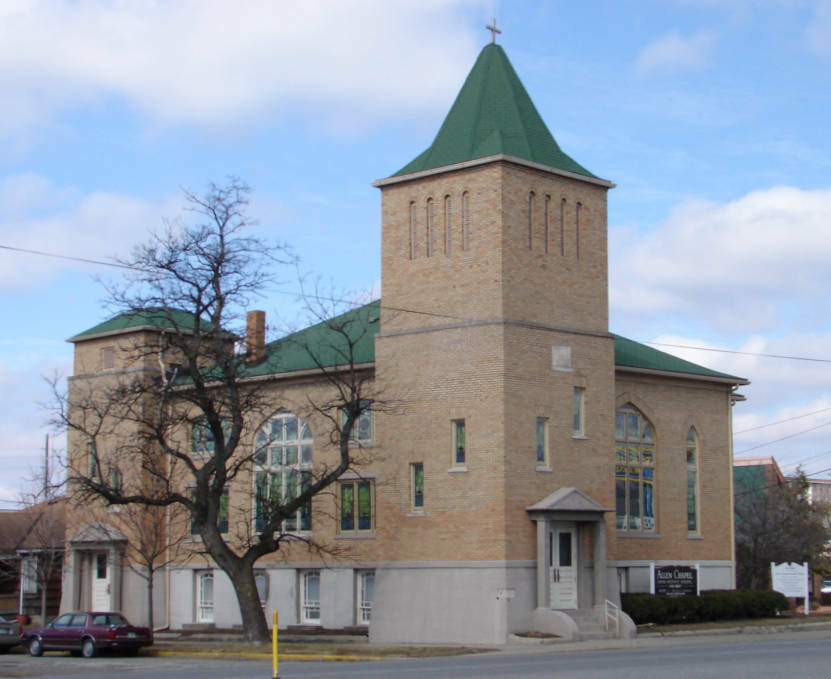
    <summary type="html"><![CDATA[<p><strong><em>Vigo County is a well-known site of early African American settlement, having close to 100 residents in 1820. ‘Lost Creek’ is identified as one of Terre Haute’s oldest Black settlements. A common identifier of Black settlement in Vigo County is the establishment of an AME church in Terre Haute. Allen Chapel African Methodist Episcopal (AME) serves as a bulwark of Terre Haute’s history, a reminder of the support which churches gave to early Black communities. Allen Chapel fits into the larger AME community of South-Western Indiana.</em></strong></p><img src="https://discoverindianahistory.org.curatescape7.reclaim.hosting/files/fullsize/4ed40527222c54ddd4c8d69339a4b217.jpg" alt="Allen Chapel" /><br/><p>Terre Haute’s Allen Chapel of the AME Church has stood at Third and Crawford Streets since 1870. However, the Terre Haute Congregation goes back to 1837, being housed in a small white church. Founding congregants enlisted the help of Rev. William Paul Quinn to assist their congregation. Allen Chapel AME served as a stop on the Underground Railroad, placed near the Wabash River route. The Terre Haute congregation is recorded as having around 74 members between 1841 and ’45.</p><p>Hiram Rhoads Revels, the pioneer of Allen Chapel’s educational mission, went on to serve as the first Black U.S. senator and, later, the first president of Alcorn State University. Similarly, James Hinton, the first Black man to serve in the Indiana General Assembly, attended Allen Chapel School. Allen Chapel set out to design a new church in 1868, enlisting Frederick Douglass to raise money for the construction. When the church was dedicated in 1870, they were presented with the bell used in the first Vigo County Courthouse. Allen Chapel trustee Zachariah M. Anderson became Terre Haute’s first Black public school teacher.  Even Jackie Robinson spoke to the congregation about his experience as a Major League Baseball player.</p><p>In 1913, a lightning strike engulfed the upper levels of Allen Chapel in flames. The unique tracker action pipe organ was saved, as well as some pews, but much of the original building was destroyed. The reconstructed Allen Church is yellow brick and stone, featuring a corner bell tower. Its prominent green roof curves into points and slopes, topping off the corner tower with a cross.</p><p>Urban redevelopments in the 1960s cut into Allen Chapel’s congregation and the building fell into minor disrepair. At a certain point demolition of the historic site became likely. Because of this threat, ‘Friends of Historic Allen Chapel AME’ formed to raise the necessary funds to preserve the building. Terre Haute’s congregation still operates to this day. Allen Chapel has been on the National Register of Historic Places since 1975.</p><p><em><strong><a href="https://discoverindianahistory.org.curatescape7.reclaim.hosting/items/show/622">For more view the original article</a></strong></em></p>]]></summary>
    <published>2023-06-21T13:43:54+00:00</published>
    <updated>2026-04-17T19:48:36+00:00</updated>
    <link rel="alternate" type="text/html" href="https://discoverindianahistory.org.curatescape7.reclaim.hosting/items/show/622"/>
    <id>https://discoverindianahistory.org.curatescape7.reclaim.hosting/items/show/622</id>
    <author>
      <name>Preston Reynolds</name>
    </author>
  </entry>
</feed>
