Filed Under Story

The Emerson School Strike of 1927 in Gary
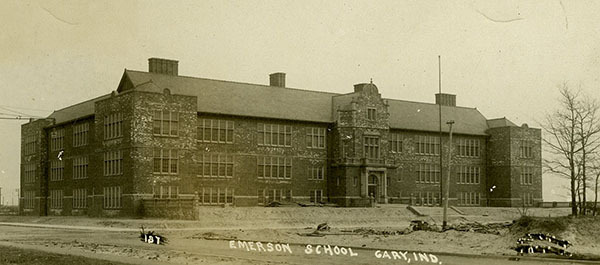
School strikes by students for any reason are rare in the history of the United States. Gary is unique in that it has had two school strikes, both motivated by white racism, in its history. Gary had one of the highest percentages of Black residents of any Northern city during this time, with Black Americans comprising 9.6% of Gary’s total population in 1920 and 17.8% of Gary’s total in 1930. Many White residents feared the large number of Black students who were already in the schools. Their fears were not only about direct physical contact with students they perceived as inferior to them, but also the sentiment that Black students did not deserve the same support as white students. 

The Emerson School Strike happened in the fall of 1927. The Emerson School was on the north side of the city and served mostly the families of “middle class and elite skilled workers.” Few European immigrants’ children attended this school. Eighteen students from the all-Black Virginia Street School, which was overcrowded and in need of modernization, were reassigned to Emerson. This increased the number of Black students at Emerson from six to twenty four, out of a total student body of about 2,800. 

Over 600 white Emerson students boycotted on the first day of the strike, Monday, September 26, 1927. They carried a banner that read, “We won’t go back until Emerson is white.” The strikers’ numbers increased to 1,357, which included about three-fourths of the high school students, by the third day of the strike. At a city council meeting held on September 30, “the idea of a totally segregated high school for [B]lacks emerged. Construction started immediately on the all-[B]lack Roosevelt High School.” In order to get the white students to return, educators and city officials agreed to re-segregate the school. The eighteen Black students who had attempted to attend Emerson School were forced to return to the Virginia Street School. No Black students would be allowed to attend Emerson. 

The Roosevelt School, which opened in 1930, complied with Indiana State law and the 1896 legal decision in Plessy v Ferguson that allowed for racial segregation so long as it was “separate but equal,” although the premise that separate could ever be equal was of course false and would be overturned in the Supreme Court’s Brown V. Board of Education 1954 decision.  

At the Froebel School in Gary, both White and Black students attended. But at Froebel, “Black seniors attended a separate prom, and their pictures were excluded from the year book. The school administration refused to permit [B]lack students to join extracurricular activities, such as Band, athletic teams, or ROTC; they could only use the swimming pool the day before it was cleaned.” This is where Gary’s second school strike happened in 1945. You can learn about the Froebel School strike here. 

Images

Emerson School
Emerson School Site of the 1927 student strike, Emerson School, the first high school in Gary, opened in the Fall of 1909. Designed by noted architect William Ittner, and named after famous philosopher and poet Ralph Waldo Emerson, it was also the first school in Gary to adopt Superintendent William Wirt’s “Work-Study-Play” system and “Unit School” (K-12) concept. During the 1980s, this building was converted into a performing arts oriented school, like the one in the movie “Fame.” Source: Gary Public Library Date: 1910
Klan Gathering
Klan Gathering The Ku Klux Klan, a nativist, white supremacist organization, based on the hatred of Catholics, Jews, immigrants, and people of color, was enormously influential in mid-1920s American politics, even essentially controlling the state of Indiana at this time. Though the number of people who lived in Gary who were even eligible to be in the Klan was low, the group still paraded (at least occasionally) in parts of the city, as shown here. Source: Calumet Regional Archives Indiana University Northwest Date: c. 1925
Roosevelt School
Roosevelt School Roosevelt School, for many years a K-12 school, and later a high school, served the African American population of Gary, due to racism and anti-integration sentiments by much of Gary’s white population. Opened in 1931, in response to the Emerson School Strike of 1927, Roosevelt is even now much revered by many current and former Gary residents, as it was one of the premier all African American schools in the country during the 1930s. Source: Gary Public Library Date: 1931
William Marshall
William Marshall One of Roosevelt School’s famous alumni was William Marshall (pictured here). The son of Thelma Marshall, a well-known leader in her own right in Gary’s African American community, William Marshall was an actor, starring in several “Blaxploitation” films of the 1970s as the character “Blacula,” a take-off on the famous horror figure “Dracula.” As you can see from the advertisement above, William Marshall did not forget his roots, as he portrayed the abolitionist leader Frederick Douglass in a play that was performed in Gary. Source: Gary Public Library Creator: Gary Community School Corporation Date: 1994
Dedication Program
Dedication Program The official program from the dedication of Roosevelt School in 1931. Notice that no mention is made of the reason for the creation of the school, or that the school was all Black. Source: Gary Public Library Date: 1931
Roosevelt Grads
Roosevelt Grads Shown here is part of the Gary Public Library’s fifty-foot long mural celebrating Gary history. Pictured are Lee Calhoun and Glenn Robinson, two great athletes who attended Roosevelt High School. Calhoun won gold medals in successive Summer Olympics, in 1956 in Melbourne, and in 1960 in Rome, in the 110-meter high hurdles in track and field. Robinson was Indiana’s Mr. Basketball as well as on the state championship boys’ basketball team in 1990-91 at Roosevelt. He was national college men’s basketball player of the year at Purdue in 1993-94, and he was on an NBA championship team with the San Antonio Spurs in 2004-05. Source: Gary Public Library Creator: Felix Maldonado Date: 2018

Location

716 E 7th Ave, Gary, IN 46402

Metadata

Gary Public Library and Rebecca Shrum, “The Emerson School Strike of 1927 in Gary,” Discover Indiana, accessed October 22, 2026, https://discoverindianahistory.org.curatescape7.reclaim.hosting/items/show/605.