Gennett Records

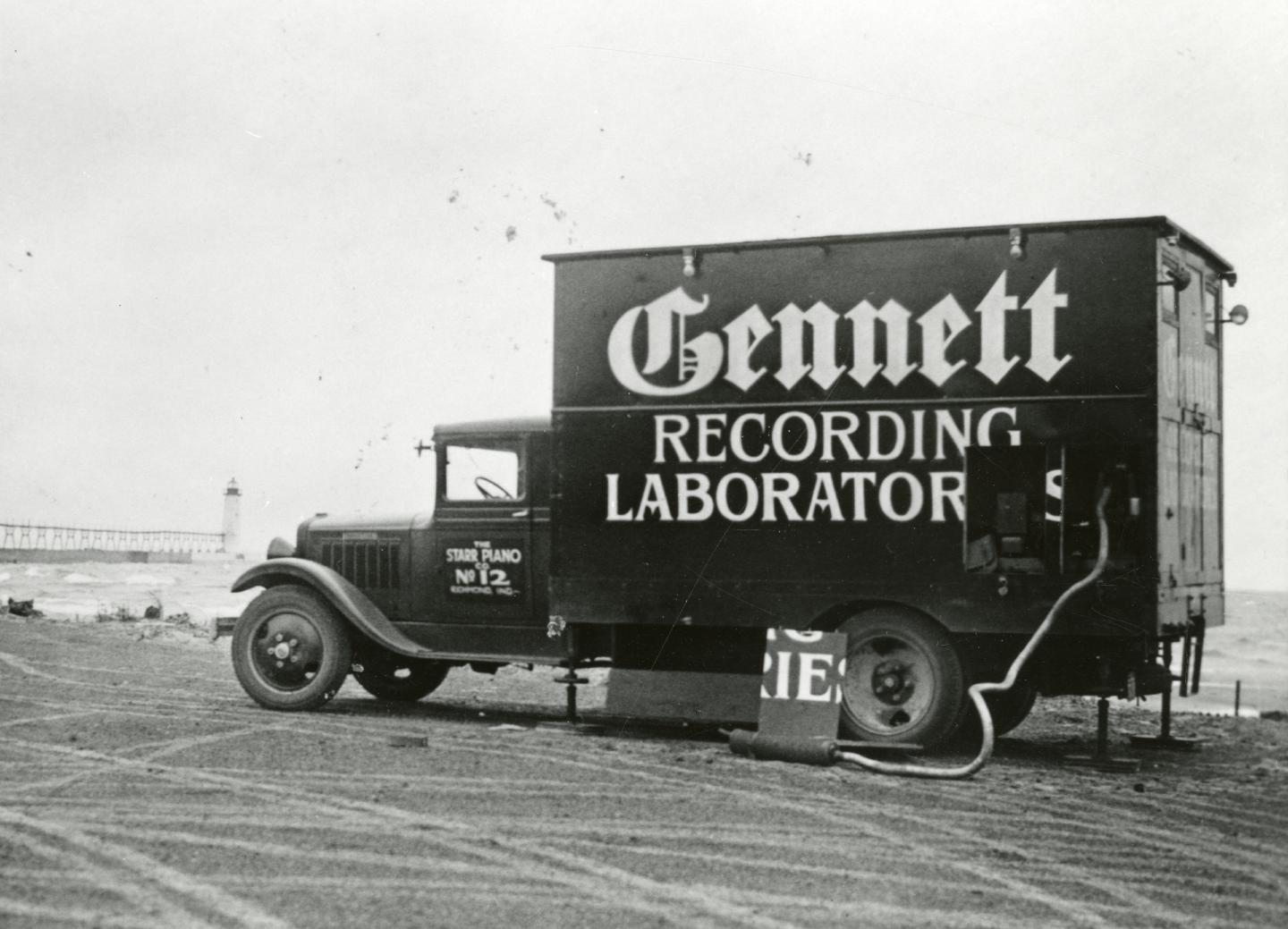
By 1915, the Starr Piano Company decided to start recording the discs to be played on those phonographs: records. Records were first issued under the Starr name until a separate division, Gennett Records, managed by Henry Gennett’s sons Harry, Clarence, and Fred, was established in 1917. The first recording studio was in Manhattan, and in 1921 the Richmond studio was established within the Starr Piano Company manufacturing complex. The studio was 125 feet long and 30 feet wide and once resided about midway along the current Walk of Fame, which begins to the right of the Logo Building, and features 34 medallions honoring some of the musicians who once recorded with Gennett. The first inductee to this Walk of Fame, Louis Armstrong, remembers a Mohawk rug being placed on the floor of the recording studio for sound proofing. The Gennett label concentrated on genres of music commonly deemed neither profitable nor potentially popular enough for the big record labels. Throughout the early and mid-1920s a stream of artists from the Midwest and South came to Richmond’s “Starr Valley”, including future legends like Louis Armstrong, Jelly Roll Morton, Bix Beiderbecke, Gene Autry, and Hoagy Carmichael among many others.
Recording the Ku Klux Klan
Gennett Records was among the earliest to record both African American and white musical styles in a largely segregated industry during a period when the Ku Klux Klan had a stronghold in Indiana. On October 5, 1923, King Oliver's Jazz Band, which included Louis Armstrong among their ranks, for example, recorded a second series of discs at the Richmond studio while a large group of Ku Klux Klan members gathered in Richmond’s Glen Miller Park for a parade. The Richmond Item had predicted it would be a “mammoth parade” with an airplane “swinging a fiery cross” as the grand finale. The following day, the Richmond Item reported that over 30,000 people were in attendance. In addition to producing records for consumer sales, Gennett also had a cash recording business, where anyone could pay to rent a studio, record their own material, and have it pressed into private records. Musical groups associated with the Ku Klux Klan, such as the “100% Americans” and the Vaughan Quartet, were among those who participated in this side of Gennett’s business. Their recordings had red labels with gold lettering, were not listed in Gennett catalogs, and were sent directly to Klan headquarters in Indianapolis. The Cradle of Recorded Jazz Richmond has often been called the “Cradle of Recorded Jazz,” yet Gennett produced a wide range of music. Many different grassroots genres had their earliest recordings created in the Starr Valley, including Gospel, blues, spirituals, country, and hillbilly. With all these different individuals and groups coming and going from the studio, Gennett’s story gives a snapshot into the vast diversity of music, culture, and politics in the United States in the 1920s.
The Cradle of Recorded Jazz
Richmond has often been called the “Cradle of Recorded Jazz,” yet Gennett produced a wide range of music. Many different grassroots genres had their earliest recordings created in the Starr Valley, including Gospel, blues, spirituals, country, and hillbilly. With all these different individuals and groups coming and going from the studio, Gennett’s story gives a snapshot into the vast diversity of music, culture, and politics in the United States in the 1920s.
Images