West 8th Street Historic District

Originally known as Anderson Street, this neighborhood and its historic homes were built on the coattails of the Anderson gas boom and the prosperity it brought. The neighborhood includes Elmo A. Funk Park, named after the founder of the Coca-Cola Bottling Company in Anderson and a former West 8th Street resident, as well as a churches and commercial and public buildings of Queen Anne, Neo-Classical, Free Classic, and Italianate styles that were in vogue among the affluent.
West 8th Street houses attest to the economic prosperity that the Industrial Revolution brought to Anderson through the gas boom, manufacturing industries, and other businesses. Industrialists as well as other businessmen hoped to cash-in on the ensuing economic growth. Anderson’s most prominent citizens formed a board of trade to promote the city of Anderson to prospective entrepreneurs as a place to business. They also advertised the West 8th street neighborhood as a place to live for the latter entrepreneurs who would dominate the upper class of Anderson, Indiana.
Neil C. McCullough (1820-1888) had been an Anderson Banker for 32 years when natural gas was discovered in Anderson in 1887. He operated the city’s sole artificial gas plant as well as the Citizen’s Banking Company, the first bank in Anderson. His house at 226 West 8th Street is of the Neo-Classical style with its unmistakable portico with fluted columns buttressing a broad cornice and tri-glyphical frieze. The house was built in 1879 and is currently occupied by a dentist’s office.
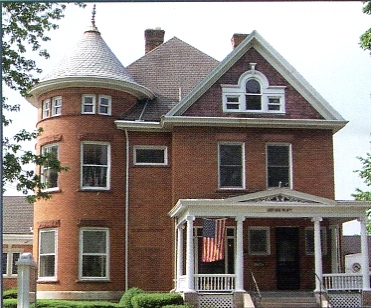
Thomas W. Wright (1849-1937) was born in England before immigrating to the United States in his twenties. He settled in Beaver Falls, Pennsylvania, where he became superintendent of a shovel factory. He relocated to Anderson in 1891 where he opened the Wright Shovel Company. He expanded his business to found the Wright-Rich Cut Glass Company, which manufactured glassware with a Pennsylvanian style of grinding designs by mass production. In 1903, his house at 403 West 8th Street of the Free Classic style was completed. It has a porch with signature columns and light entablature, but perhaps its preeminent feature is its round tower with its conical roof of slate tiles and ending with a finial. In the 1920s, it was home to Charles E. Wilson (1890-1961), then president and general manager of the Delco-Remy Corporation and future president of General Motors and secretary of defense in the administration of Dwight D. Eisenhower. Today, it houses the law firm of Howard, DeLey & Garrett.
The J.W. Sefton Manufacturing Company was a pioneer in the production of corrugated paperboard. Brooks Sefton, of the company as well as the family, resided at 322 West 8th Street in a house that was built in 1896. This house is a hybrid of the Free Classic and Queen Anne styles. Its columned porch and- first-and-foremost-its two-story turret with conical roof are consistent with the Free Classic style. However, its steep roof, asymmetrical façade, decorative shingles, and round turret tower are Queen Anne style. It was insulated with the corrugated paperboard produced by the Sefton factory. Reputedly, 322 West 8th Street is one of the first fully insulated houses in the United States. At present, it is a private home.
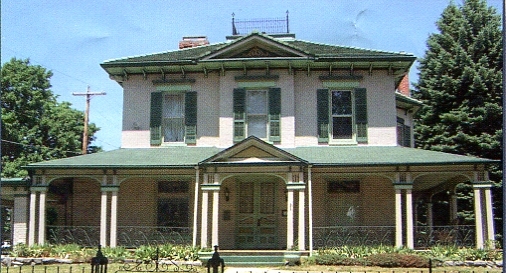
John H. Terhune (1847-1909) was president of the Anderson Foundry and Machine Works and Mayor of Anderson from 1891 to 1894. With the discovery of gas, the Foundry and Machine Works expanded dramatically to meet the demand for machine parts. His house at 212 West 8th Street is of the Italianate style marked by a symmetrical appearance, wide bracketed eaves, colonnaded porch, and a wrought iron widow’s walk. Mr. Terhune built his home in 1886. His family resided there until 1913, when the property was to the Toner family, who owned the former Anderson Herald. Currently 212 West 8th Street is a private home.
The legendary “Hoosier Poet” James Whitcomb Riley (1849-1916) resided at 501 W 8th Street in Anderson. He was employed as a reporter by the Anderson Democrat from 1874 to 1878, before moving on to greater fame with his poems written in the Hoosier dialect, such as “Little Orphant Annie” and “The Raggedy Man.” Although the house he lived in is no longer standing, a storefront named Riley Place occupies its address.
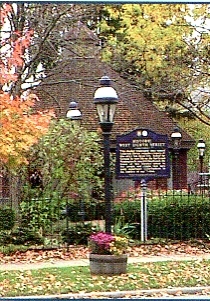
Elmo Funk Memorial Park is located on West 8th Street between Chase and Lincoln Streets. It is named after Elmo Ambrose Funk (1889-1968), who served as Anderson’s city engineer. Funk founded the Coca-Cola Bottling Company in Anderson. Mr. Funk, who resided at 920 W. 8th Street (now a private home), was a prominent civic leader in the community of Anderson. In 1973, his son Thomas Clement Funk (1916-1997) donated the land on which the park was built. It features a brick path, a water fountain, a gazebo, and an array of trees and flowers.
People such as the aforementioned homeowners were among the biggest employers in the city of Anderson. Their businesses employed thousands of Anderson residents through the years. In addition, there were people residing in Anderson who found work in these very homes as domestics. Elmo Funk Memorial Park is place for everyone to enjoy on West 8th Street, whereas in yesteryear this neighborhood was where the privileged class and not the plebeian masses could afford to live.
Images