Filed Under Story

Construction of the Mill

Unlike other well-known centers of industry, such as Pittsburgh or Detroit, where the cities significantly predated the beginning of industrial development in those areas, Gary’s history as a city begins with US Steel. In the early twentieth century, US Steel Corporation needed a plant in the Midwest so that it could better meet the demand for steel of customers in that region. The steel industry had boomed in the U.S. in the decades following the Civil War. The U.S. steel industry produced 10 million tons of steel in 1900 and 24 million tons in 1910. Steel was used for railroads, bridges, buildings, household appliances, and automobiles.

US Steel used what were known as “scientific location of industry” principles to select the Gary location. The site was roughly equidistant from where the key materials for the manufacture of steel would be coming from: iron ore from the mines of Northeast Minnesota, limestone from mines in Michigan, and coal from the mines of the Appalachian Mountains. The Gary site was also close to Chicago, which could provide a source for workers as well as access to the Chicago railroad system, making it cheaper to move goods. The State of Indiana also offered lower property taxes than Waukegan, Illinois, which was another location the company considered. US Steel paid $7.2 million to purchase 9,000 acres (the equivalent of over $207 million in 2019). The mill and city then had to be built from the ground up including roads and other infrastructure.

The area where the town was to be built was also covered in sand dunes, dense grasses, trees and enormous swamps. The sand dunes had to be drained and leveled. This was an area that was home to prehistoric glaciers that formed the dunes and sunken landscapes that remain today on the city’s west side. The high ridge landscape, several miles south, is a reminder that the lake level 5,500 years ago stood twenty-three feet higher than today, according to the Indiana Geological & Water Survey website.

In order to build the city, the sand dunes in the area had to be leveled and the swamps drained. The Grand Calumet River also had to be moved 1,000 feet south of its previous route. Builders also had to contend with Lake Michigan. A significant portion of the lake abutting the proposed city had to be filled in. Once that was completed they also had to build two parallel piers, almost a mile long, that projected almost half a mile out into the lake to create a harbor for arriving ships with raw materials. The harbor alone cost almost $2.5 million in 1908 (the equivalent of around $72 million in 2019). The cost of the entire Gary project, including the town as well as the mill, was almost $43 million in 1908. In 2019, it would cost a corporation over $1.2 billion to build similar facilities and a surrounding city.

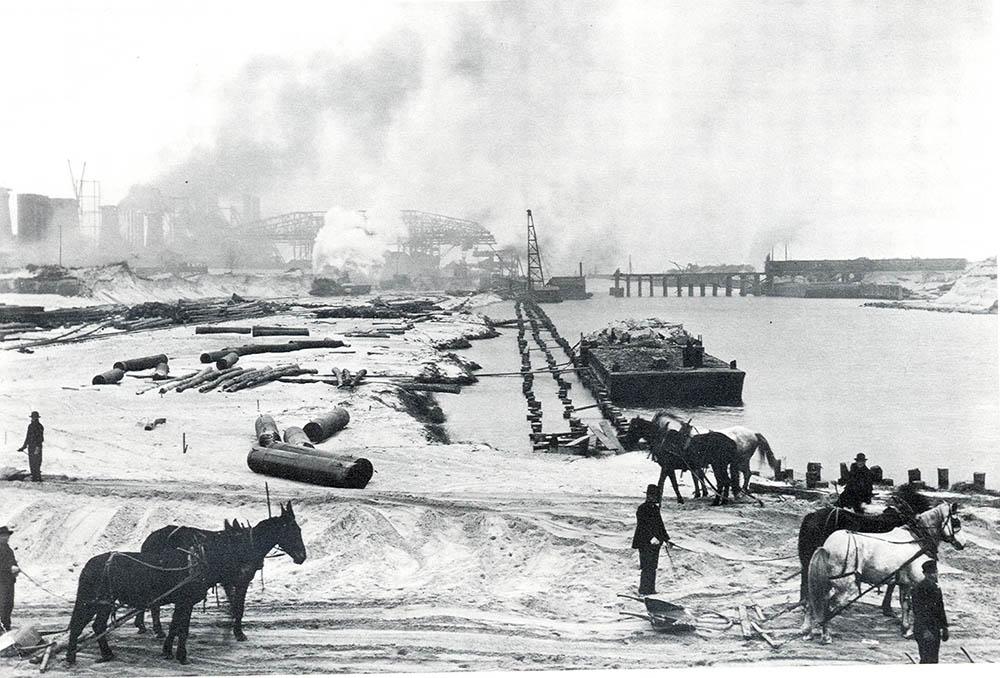
Construction for the mill itself was done by men using teams of horses and mules. Workers were housed in tents or in “McFadden’s Flats,” a bunkhouse with sixty cots and no indoor bathroom. The construction of the mill took two years. The completed mill was the largest steel mill in the world.

Images
Leveling Dunes
Leveling Dunes Before construction could even start on the steel mill, the sand dunes on the site of the future mill had to be graded (leveled). Constructing the plant took excavating more than eleven million cubic yards of material. Note that workers with teams of horses (also mules, not pictured) were used for this task, instead of mechanized equipment, let alone heavy machinery. Source: Gary Public Library Date: 1906
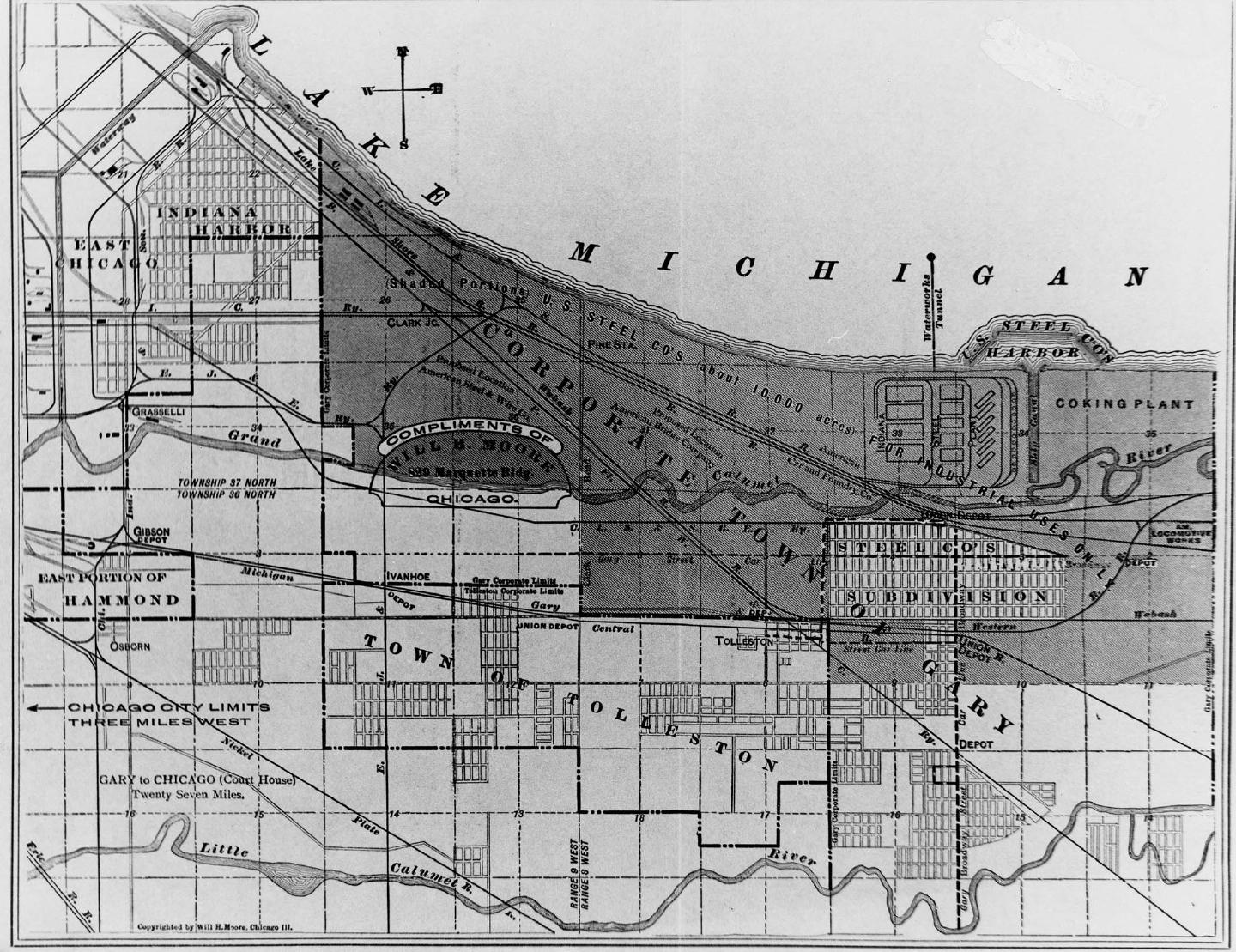
Early Gary Area
Early Gary Area This is a map of Gary and surrounding area in 1906, the first year of Gary’s existence. This shows that the overwhelming majority of the 9,000 acres of the original “Corporate Town of Gary” was devoted to the steel mill, with a mere 800 acres allotted to the residential part of the town. Note the neighboring community of Tolleston (annexed by Gary in 1910), and parts of the neighboring cities of Hammond and East Chicago. Source: Gary Public Library Date: 1906
Fusion Sculpture
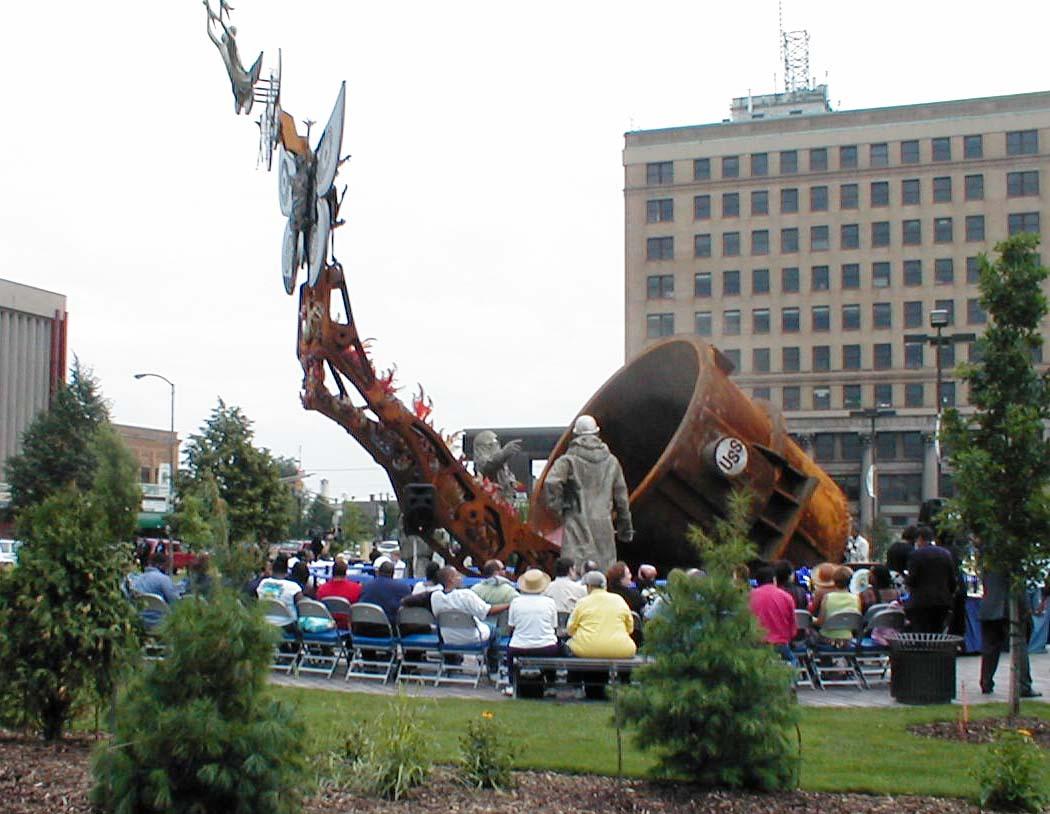
Fusion Sculpture Located south of the Gary Steel Mills, within Gary’s historic downtown, “The Fusion” sculpture was created for the city’s Centennial in 2006. It represents the “fusing together” of many different cultures in Gary. The sculpture was created by Omri Amrany, who was also commissioned to create the Michael Jordan statue outside the United Center in Chicago. Source: Gary Public Library Creator: Maria Strimbu Date: 2006
Bird Foot Violet
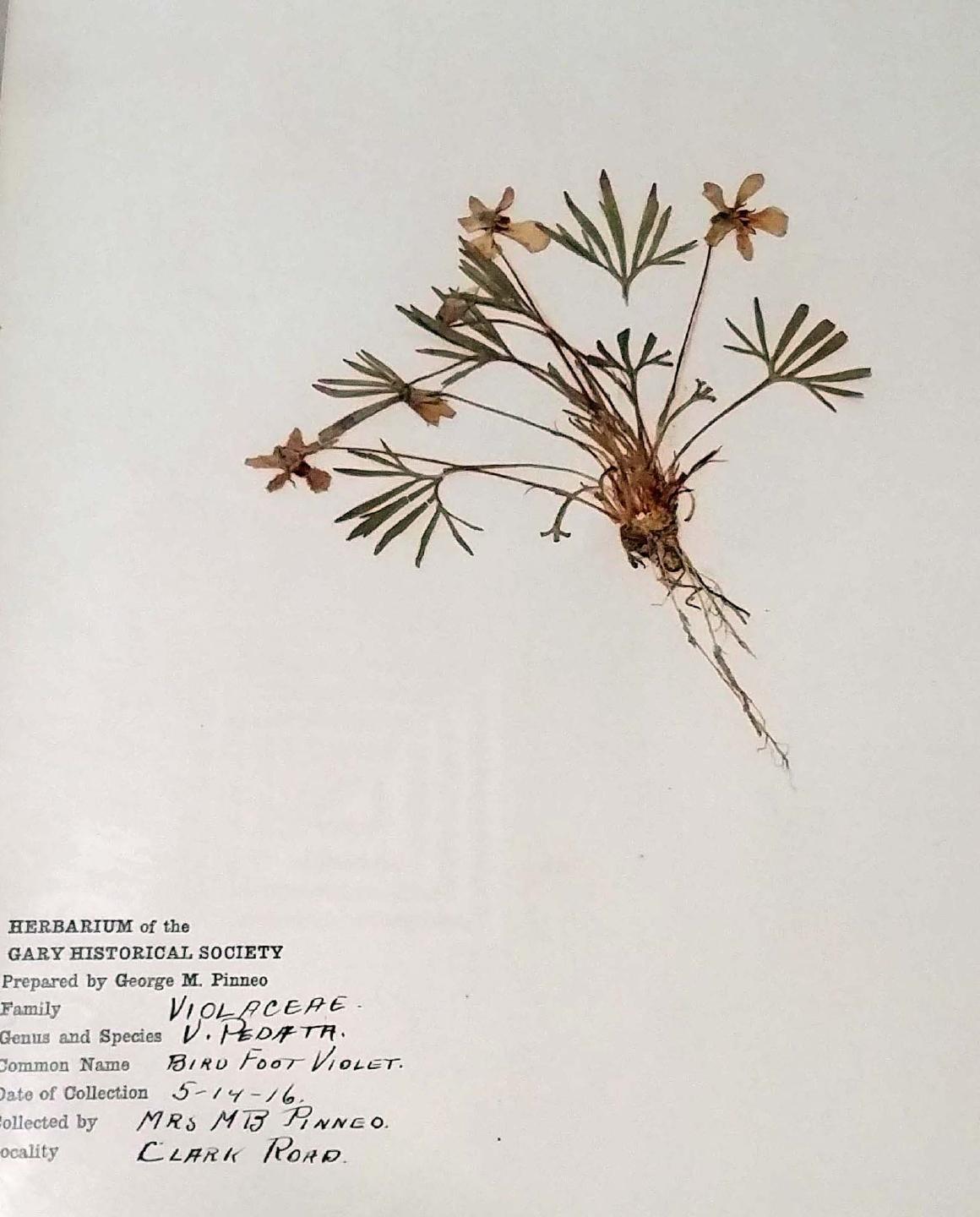
Bird Foot Violet The Bird Foot Violet, Viola Pedata, is a plant of the true sandy oak savannas and a staple of the northern reaches of Lake County and the Indiana Dunes. This herbarium sample was collected in 1916 and is part of the Gary Public Library’s collection of over sixty botanical specimens. George M. Pinneo, an active botanist, who also served as Gary YMCA director, and was an Olympic wrestling coach, prepared the samples in the collection. Source: Gary Public Library Creator: George M. Pinneo Date: 1916
Opening Grand Cal
Opening Grand Cal An actual river had to be moved in order to accommodate the US Steel plant. The Grand Calumet River was moved 1,000 feet south of its previous location, so that the steel mill could be located in the best possible position on the land US Steel owned. Workers had to contend with hornets, yellow jackets, dune fleas, and snakes. In total, almost two miles of the river was straightened. The river, in its new position, was now located between the mill and the town. The huge shovel that is doing the digging is steam powered. Source: Calumet Regional Archives Indiana University Northwest, Gary, IN Date: 1907
Harbor Slip
Harbor Slip The steel plant’s harbor was specially built to accommodate the large boats used for transporting ore. A 23-foot deep channel was dug, with a turning basin at its south end. The harbor was built at the cost of almost $2.5 million at the time, which in 2019 would have been around $72 million. The first blast furnace started operation a month after this photo was taken. Source: Calumet Regional Archives Indiana University Northwest, Gary, IN
Mill Panoramic
Mill Panoramic The first iron ore boat arrived at the steel mill on July 23, 1908. The load was picked up in Minnesota, and therefore had to travel across Lake Superior as well as Lake Michigan to get to Gary. In 1912, the steel mill was fully operational. Notice how much land is needed for a steel mill. At the time, this steel mill had the largest rail mill in the world. Source: Library of Congress, Prints & Photographs Division (Follow this link for access to a high-resolution copy of this image: 6a19346) Creator: Crose Photo Co. Date: 1912
Steel Ore Boat
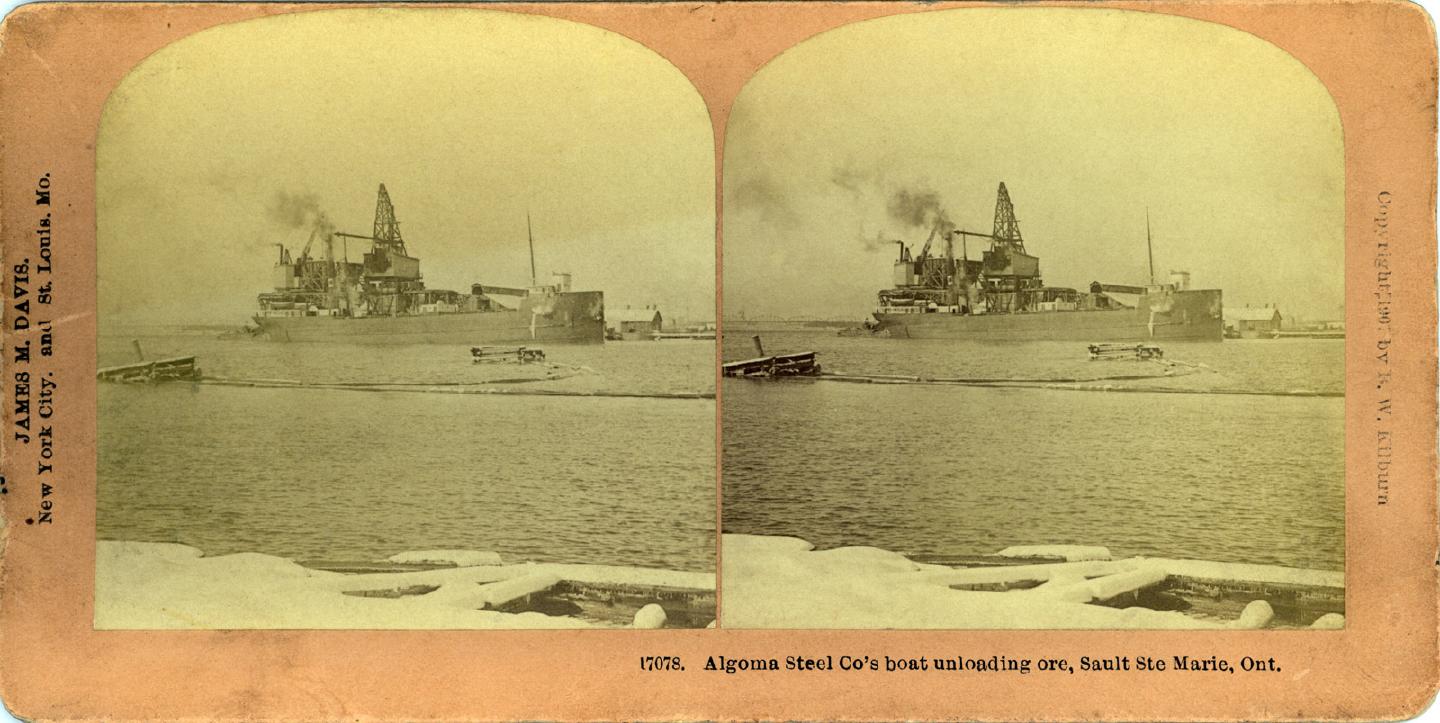
Steel Ore Boat A freighter unloading iron ore at Sault Sainte Marie, Ontario for the Algoma Steel Company. Ships like these were used at US Steel as well. Source: Maritime History of the Great Lakes [Image available here] Creator: B.W. Kilburn Date: 1907
City Seal 3
City Seal 3 Promoters referred to Gary as a “miracle city,” a “magic city,” and the “city of the century.” “City of the Century” was also used on the official city seal, which depicts a globe being covered with oil. Source: Via Wikimedia Commons (Gary Seal)

Location

1 Genesis Center Plaza, Gary, IN 46402

Metadata

Gary Public Library, “Construction of the Mill,” Discover Indiana, accessed October 22, 2026, https://discoverindianahistory.org.curatescape7.reclaim.hosting/items/show/600.