Building a City for Workers
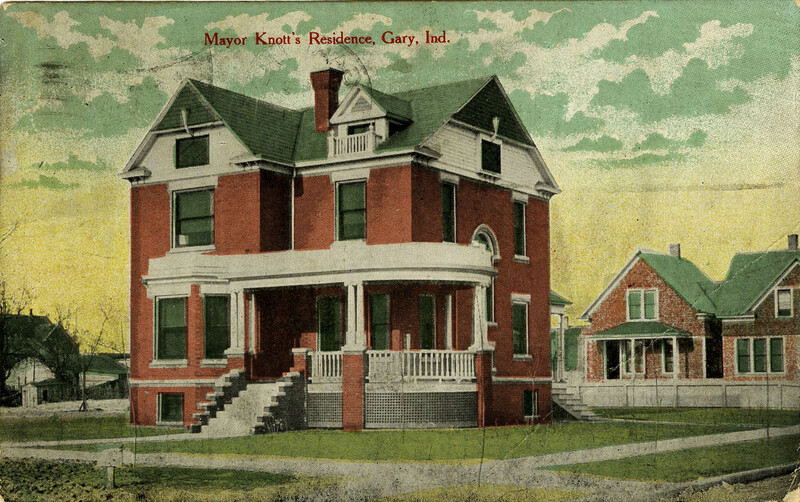
The Gary Land Company’s First Subdivision covered the area from just south of the Steel Mill Entrance south to the Wabash tracks (9th Avenue), and from Tennessee Street west to Fillmore Street. In the First Subdivision, restrictions and controls provided a consistent, clean, and orderly appearance. This not only lowered the costs of the houses, but presented the area as a modern place for workers. Houses constructed in the First Subdivision were largely built for mill supervisors, upper management, and higher-paid workers, those with jobs that required knowledge of machinery or technical processes, such as electricians, bricklayers, or engineers. All of these employees of US Steel were usually white men who were born in the U.S. Most of the lower-paid workers were immigrants from eastern and southeastern Europe.
For the first three years (1906-09) of the subdivision’s existence, the steel company provided homes by entering into a contract with residents. An employee would purchase a single lot, and then had 18 months to erect a “building of specified quality.” By specified quality, the company meant that it needed to be built to US Steel standards. If the employee failed to complete construction, the company took back the deed. This was obviously a challenge even for workers making a good wage. The costs of goods and the time it would take for construction was a challenge when workers had to put in twelve-hour shifts up to seven days a week. It was unsurprising that the Gary Land Company would later step in and start to build and sell houses directly to workers rather than asking them to take care of construction themselves.
The First Subdivision included 506 houses, in a variety of approved styles. While most houses were smaller, the most expensive houses (206 of 506) were quite large, with five to ten rooms, depending on the status of the worker. Sturdy and well built, the housing stock in this area included all-concrete homes that had been patented by the famous inventor Thomas Edison as well as two homes designed by the legendary architect Frank Lloyd Wright. The variety of size and style presented a much less monotonous appearance than the average company town, which used limited floor plans and styles. The cost of this upgraded approach was steep, though.
Homes rented from $23 to $42 per month. Most laborers averaged only 16.7 cents per hour in 1912. Even for a worker employed 12-hours a day, seven days a week, the monthly wage at the average rate would be $60. All of the most expensive homes were west of Broadway. Less expensive, but still too expensive for most immigrant families, were the 200 six-room houses that the company built on scattered lots east of Broadway, and the ninety four houses in Kirksville (in the extreme northwest corner of the First Subdivision) that were made up of four to six-rooms each. The company also built fifty uniform, wooden frame, 4-room homes in the northeast corner of the First Subdivision for the lowest paid workers who were mostly immigrants. These houses, which left much to be desired, were often referred to as “double dry goods boxes.”
Housing construction was especially brisk during the “Roaring Twenties” (1920s), when many of the homes were constructed to reflect styles such as American Prairie, Craftsman, Tudor, Georgian Colonial, French, and Italianate. Some of these homes were impressive, even luxurious, while many others were more affordable bungalows. Designs by local architects sat side by side with those of Chicago architects Dean and Dean, who were commissioned by the Gary Land Company to supply over a dozen different architectural housing designs for mill workers. This neighborhood was comparable to some of the best residential areas in the country. The portion of this neighborhood west of Broadway was the most exclusive area in Gary until the 1950s or 1960s, when the Miller area supplanted it.
The Gary Land Company housing stood in sharp contrast to the housing south of the Wabash tracks, which was predominantly inhabited by the immigrant (and later also African American) working class employees. Because of the restrictions and costs of living in the First Subdivision, laborers who came by the thousands from all over the world and the American South had to find housing elsewhere. The housing south of the Wabash tracks consisted mostly of shacks and other substandard housing for a number of years after the construction of the town.
The challenging living conditions south of the Wabash tracks just added to the misery of the workers who lived there, who already had to deal with severe working conditions inside the mill. Moreover, work conditions in the steel mill were not only harsh, but also tedious. The mill was hot (since the steel had to be heated to very high temperatures [2,700-3,000 degrees F.]), loud (with machinery always being in use), and dirty (both due to smoke and dust from the processing of steel, and from the remains of the waste products of steel). No matter where one worked on the floor, the building would have an ugly interior appearance, and would be very large, with all of the workers being dwarfed by the scene. This was a very dangerous place to work, with few or no safeguards at this time, and serious injuries and deaths were not unusual. In fact, there was a hospital right on the steel mill’s property at this time (it opened in 1910, only a little more than a year after steel production started), since such facilities were so frequently needed. It didn’t help that many workers worked 12 hours per day, 7 days per week, until 1923.
Images


